The Three Layers Every Production RAG System Needs
RAG still matters even with million-token context windows - stuffing everything in is slower, costlier, and less accurate than retrieving what the model actually needs. Production systems need three layers: document parsing that preserves structure (Docling), hybrid keyword-plus-vector search (OpenSearch), and orchestration for the messy reality (LangChain). Most failures trace back to layer one.
“Context windows are huge now, do we even need RAG?”
Yes. Even with million-token windows, stuffing everything in is expensive, slow, and less accurate than giving models exactly what they need.
But most RAG tutorials skip the hard parts. Here’s what actually matters.
The Three Layers
Every production RAG system needs:
- Document parsing that doesn’t destroy structure
- Hybrid search combining keywords and semantics
- Orchestration that handles the messy reality
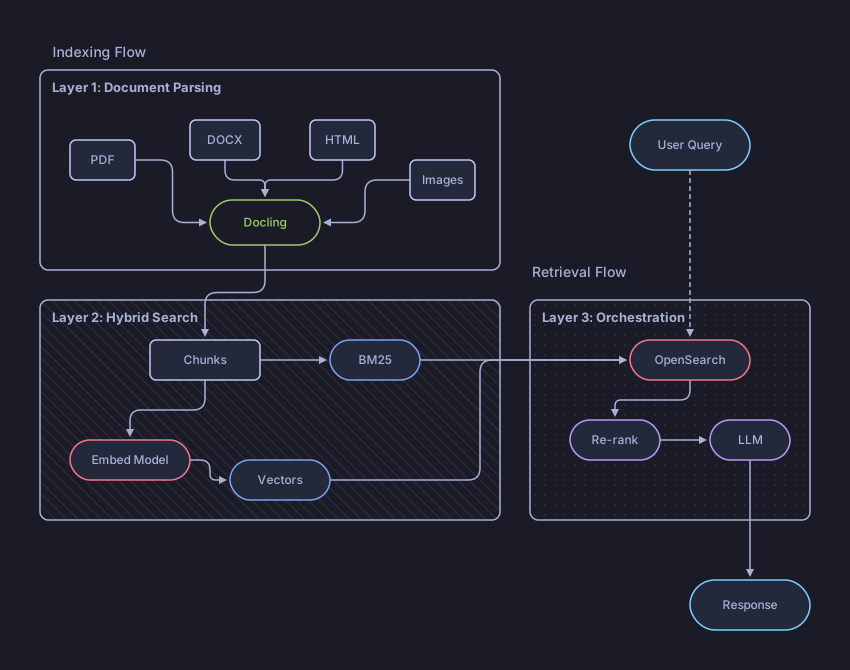
Most demos skip layer one entirely and oversimplify the rest. That’s why they fail on real documents.
Layer 1: Document Parsing with Docling
This is where most RAG systems quietly fail. Real documents have tables, multi-column layouts, images, code blocks, and formulas. A naive PDF-to-text converter mangles all of it.
Docling is an open-source parser that actually handles this. Feed it a complex PDF and it preserves structure - tables stay as tables, columns maintain reading order, code blocks stay intact.
pip install langchain-doclingfrom langchain_docling.loader import DoclingLoader
loader = DoclingLoader(file_path="document.pdf")
docs = loader.load()
for doc in docs:
print(doc.page_content)Docling supports PDF, DOCX, PPTX, XLSX, HTML, images with OCR, and even audio files with speech recognition. The LangChain integration handles chunking automatically.
Garbage in, garbage out. Fix your parsing first.
Layer 2: Hybrid Search with OpenSearch
Pure vector search misses exact matches (“GDPR compliance” might not surface documents that literally say “GDPR compliance”). Pure keyword search misses semantic relationships. You need both.
OpenSearch handles this well - vector similarity and BM25 keyword search in a single query, results ranked by a weighted combination.
pip install opensearch-py langchain-community langchain-openaifrom langchain_community.vectorstores import OpenSearchVectorSearch
from langchain_openai import OpenAIEmbeddings
embeddings = OpenAIEmbeddings()
# Index your documents
docsearch = OpenSearchVectorSearch.from_documents(
docs,
embeddings,
opensearch_url="http://localhost:9200"
)
# Search with hybrid scoring
results = docsearch.similarity_search(
"What are the compliance requirements?",
k=5
)Other options like Weaviate and Pinecone offer similar hybrid capabilities. The key insight: retrieval quality directly determines response quality. Spend time tuning your search before optimizing prompts.
Layer 3: Orchestration with LangChain
A real RAG pipeline isn’t just “search and generate.” You need query rewriting, re-ranking, source attribution, fallback handling, and conversation memory.
from langchain.chains import RetrievalQA
from langchain_openai import ChatOpenAI

llm = ChatOpenAI(model="gpt-4o")

qa_chain = RetrievalQA.from_chain_type(
    llm=llm,
    chain_type="stuff",
    retriever=docsearch.as_retriever(search_kwargs={"k": 5}),
    return_source_documents=True
)

result = qa_chain.invoke({"query": "What are the main compliance requirements?"})
print(result["result"])
print(result["source_documents"])
For more complex pipelines, use LCEL (LangChain Expression Language) to compose retrieval, reranking, and generation steps with full control over the flow.
The Bottom Line
Three layers: parsing, search, orchestration. Most failures trace back to layer one - bad document parsing that corrupts your knowledge base from the start.
Get the parsing right with Docling. Use hybrid search, not just vectors. Build orchestration with LangChain that lets you iterate. Everything else is optimization.
ciao